Warren Truss: How It Works, With a Worked Example
A Warren truss has parallel chords joined by diagonals alone, zigzagging into a row of triangles, with no verticals. Under load the diagonals take tension and compression in turn. It uses fewer members than a Pratt or Howe truss, and every web member is the same length, which makes it simple to build. James Warren and Willoughby Monzani patented it in Britain in 1848. Today it's common in bridges, and the open web steel joists that hold up many roofs use a Warren-type web.
This tutorial works out every member force in a 36 ft Warren truss by hand, checks the critical members to the American Institute of Steel Construction (AISC) 360-22 specification, and compares the results with the free frame designer.
The example truss
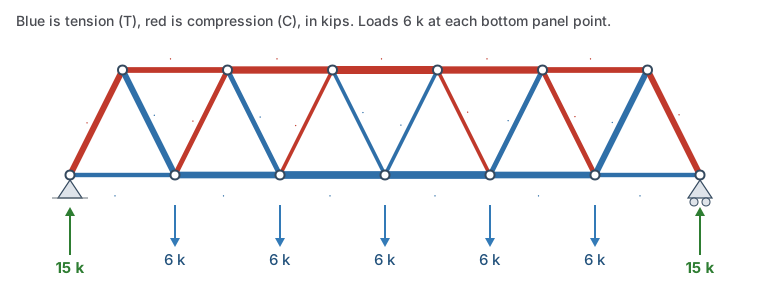
- Span 36 ft and 6 ft deep, with bottom chord joints every 6 ft and top chord joints halfway between them, at 3, 9, 15 ft and so on.
- Each diagonal runs 3 ft across and 6 ft up, so it's √(3² + 6²) = 6.71 ft long.
- Pinned at the left end and on a roller at the right.
- A load at each of the five inside joints of the bottom chord: 2 kips dead load and 4 kips live load, 6 kips in all.
- Chords are HSS4x4x1/4 and diagonals HSS3x3x1/4 hollow structural sections (HSS), A500 Grade C steel (yield stress Fy = 50 ksi): the same as the Pratt and Howe examples.
The hand calculation treats every joint as a pin, so each member carries axial force alone, and leaves out the members' own weight.
Step by step
Step 1: reactions
The five loads add to 30 kips, and the truss is symmetric, so each support takes R = 15 kips.
Step 2: the end diagonal, by the method of joints
At the left support only the bottom chord and the end diagonal meet. The diagonal is the only one that can balance the 15 kip reaction. Its vertical component is 6/6.71 = 0.894 of its force:
Fdiagonal × 0.894 = 15 → Fdiagonal = 16.8 kips compression
Its horizontal component is 16.8 × 3/6.71 = 7.5 kips, which the first bottom chord panel balances with 7.5 kips tension.
Step 3: the diagonals, from the shear
Both diagonals in a panel carry that panel's shear: 15 kips in the first panel, 9 kips in the second and 3 kips in the third. Each diagonal's force is the shear divided by 0.894, so the diagonals carry 16.8, 10.1 and 3.4 kips. In each panel, the diagonal that rises toward the middle of the span is in compression, and the one that falls toward it is in tension.
Step 4: the chords, by the method of sections
Each chord force is the bending moment at the joint across from it, divided by the 6 ft depth. For the middle top chord, between the top joints at 15 and 21 ft, take moments about the bottom joint at 18 ft:
M18 = 15 × 18 − 6 × 12 − 6 × 6 = 162 kip·ft → Ftop = 162 / 6 = 27 kips compression
For the bottom chord between 12 and 18 ft, take moments about the top joint at 15 ft:
M15 = 15 × 15 − 6 × 9 − 6 × 3 = 153 kip·ft → Fbottom = 153 / 6 = 25.5 kips tension
The same steps give 15 and 24 kips compression in the other top chord panels, and 7.5 and 19.5 kips tension in the other bottom chord panels. The top chord only runs from 3 to 33 ft: there's no top chord over the supports, since the end diagonals bring the reactions straight up into it.
Checking the members
These checks use allowable strength design (ASD), with the safety factor Ω = 1.67 and the full 6 kip loads (D + L). The top chord is taken as braced out of its plane at every joint.
| Member | Force | Allowed (Pn/Ω) | Ratio |
|---|---|---|---|
| End diagonal, HSS3x3x1/4, 6.71 ft | 16.8 kips C | 49.7 kips | 0.34 |
| Second diagonal, HSS3x3x1/4 | 16.8 kips T | 50 × 2.44 / 1.67 = 73.1 kips | 0.23 |
| Top chord at midspan, HSS4x4x1/4, 6 ft | 27.0 kips C | 85.6 kips | 0.32 |
| Bottom chord at midspan, HSS4x4x1/4 | 25.5 kips T | 50 × 3.37 / 1.67 = 101 kips | 0.25 |
The end diagonal's buckling strength (AISC 360-22 E3):
- Slenderness: KL/r = (6.71 × 12) / 1.11 = 72.5, with K = 1 for pinned ends.
- Elastic buckling stress: Fe = π²E/(KL/r)² = π² × 29,000 / 72.5² = 54.4 ksi.
- Fy/Fe = 0.92, under 2.25, so Fcr = 0.6580.92 × 50 = 34.0 ksi.
- Allowed load: 34.0 × 2.44 / 1.67 = 49.7 kips.
The Warren's compression diagonals are shorter than a Howe's (6.71 ft against 8.49 ft) and carry less (16.8 kips against 21.2), so the same tube passes easily. A truss whose loads land on the top chord, such as a roof, loads the Warren's top joints instead; the steps are the same.
Run it in the frame designer
Open this Warren truss in the frame designer
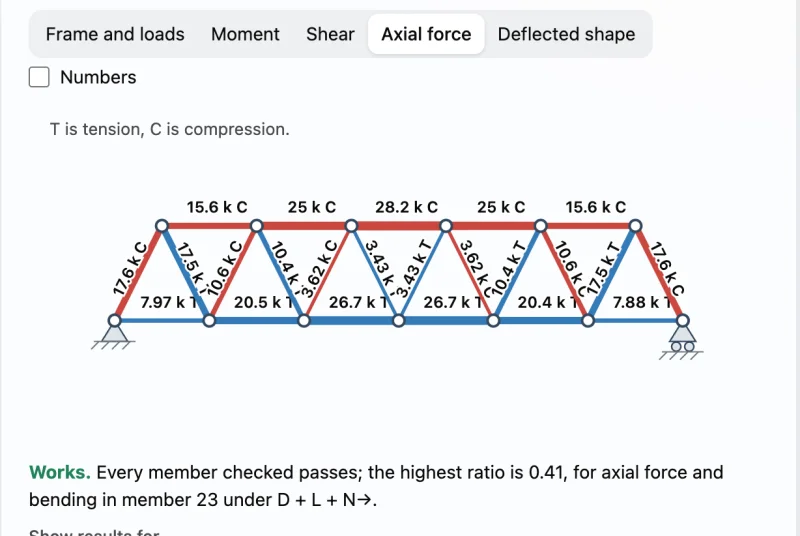
The frame designer adds the members' own weight, so its forces are a little higher: 28.2 kips in the middle top chord, 26.7 kips in the middle bottom chord and 17.5 kips in the end diagonals. Its highest ratio is 0.41, in an end diagonal, against 0.34 by hand, since it also checks the small bending from self-weight together with the axial force (AISC 360-22 H1).
Warren, Pratt and Howe compared
The same 36 ft truss with the same sizes and loads, laid out three ways:
| Warren | Pratt | Howe | |
|---|---|---|---|
| Members | 23 | 25 | 25 |
| Diagonals | Alternate | Tension | Compression |
| Verticals | None | Compression | Tension |
| End diagonal | 16.8 kips C | 21.2 kips T | 21.2 kips C |
| Largest top chord force | 27.0 kips C | 27.0 kips C | 24.0 kips C |
| Largest bottom chord force | 25.5 kips T | 24.0 kips T | 27.0 kips T |
| Highest ratio in the frame designer | 0.41 | 0.38 | 0.73 |
Frequently asked questions
Which members of a Warren truss are in tension?
Under gravity load the bottom chord is in tension and the top chord in compression. The diagonals alternate: in each panel the one rising toward the middle of the span is in compression, and the one falling toward it is in tension.
Does a Warren truss have verticals?
The original doesn't. A common variant adds verticals, which pick up loads between the triangles' points and shorten the panels of the chords.
Why are Warren trusses used for steel joists and bridges?
Fewer members and joints, all web members the same length, and forces that spread fairly evenly between tension and compression. That makes them cheap to fabricate in steel.
Can I change the span or the number of triangles?
Yes. Open the example in the frame designer and move or add joints, or change the sizes and loads. It analyzes up to 50 joints.