Pratt Truss: How It Works, With a Worked Example
A Pratt truss has parallel top and bottom chords, verticals at each panel point, and diagonals that slope down toward the middle of the span. Under gravity load that layout puts the diagonals, the longest web members, in tension and the short verticals in compression. Steel is efficient in tension and long members are the ones that buckle, so the Pratt suits steel bridges and roofs. Thomas and Caleb Pratt patented it in 1844, and it became one of the most common railroad bridge trusses in North America.
This tutorial works out every member force in a 36 ft Pratt truss by hand, checks the critical members to the American Institute of Steel Construction (AISC) 360-22 specification, and compares the results with the free frame designer.
The example truss
- Span 36 ft in six 6 ft panels, 6 ft deep, so the diagonals are at 45°.
- Pinned at the left end and on a roller at the right.
- A load at each of the five inside panel points of the bottom chord, as in a bridge whose deck sits on the bottom chord: 2 kips dead load and 4 kips live load, 6 kips in all.
- Chords are HSS4x4x1/4 and web members HSS3x3x1/4 hollow structural sections (HSS), A500 Grade C steel (yield stress Fy = 50 ksi).
The hand calculation treats every joint as a pin and the loads as acting only at joints, so each member carries axial force alone. It leaves out the members' own weight, about 0.9 kips at each support.
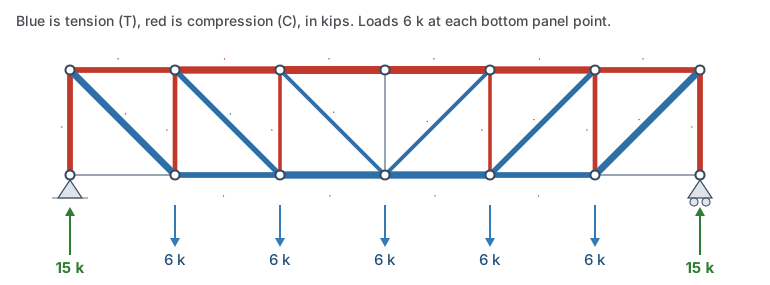
Step by step
Step 1: reactions
The five loads add to 30 kips. The truss and its loads are symmetric, so each support takes half:
R = 30 / 2 = 15 kips
Step 2: the end of the truss, by the method of joints
At the left support only two members meet: the bottom chord and the end vertical. The bottom chord is horizontal, so it can't balance the 15 kip reaction. The end vertical takes all of it, 15 kips compression, and the first bottom chord panel carries nothing.
At the top of that vertical, the vertical pushes up with 15 kips. The end diagonal is the only other member with an upward or downward component, so at 45°:
Fdiagonal × sin 45° = 15 → Fdiagonal = 15 × √2 = 21.2 kips tension
Its horizontal component, 15 kips, is balanced by the first top chord panel: 15 kips compression.
Step 3: the chords at midspan, by the method of sections
Cut through the third panel, between 12 and 18 ft, and take moments about the bottom joint at 18 ft, where that panel's diagonal and bottom chord meet. Only the top chord force is left in the equation:
M = 15 × 18 − 6 × 12 − 6 × 6 = 162 kip·ft → Ftop = 162 / 6 = 27 kips compression
The chord force is the beam bending moment at that point divided by the truss depth. Moments about the top joint at 12 ft give the bottom chord in the same panel:
M = 15 × 12 − 6 × 6 = 144 kip·ft → Fbottom = 144 / 6 = 24 kips tension
Step 4: diagonals and verticals, from the shear
Each panel's diagonal carries that panel's shear. The shear is 15 kips in the first panel, 15 − 6 = 9 kips in the second and 9 − 6 = 3 kips in the third, so the diagonals carry 21.2, 12.7 and 4.2 kips tension. Each vertical carries the shear of the panel on its inside: 9 kips and 3 kips compression. The middle vertical carries nothing, because the two diagonals meeting at the middle bottom joint hold up its load between them.
Tension in the diagonals and compression in the verticals is the Pratt's pattern. A load at a bottom panel point pulls down on the joint, and the diagonal sloping up and away from it pulls back.
Checking the members
These checks use allowable strength design (ASD), with the safety factor Ω = 1.67 for both tension and compression and the full 6 kip loads (D + L). The top chord is taken as braced out of its plane at every panel point, by the floor beams for example.
| Member | Force | Allowed (Pn/Ω) | Ratio |
|---|---|---|---|
| End diagonal, HSS3x3x1/4, 8.5 ft | 21.2 kips T | FyAg/Ω = 50 × 2.44 / 1.67 = 73.1 kips | 0.29 |
| Top chord at midspan, HSS4x4x1/4, 6 ft | 27.0 kips C | 85.6 kips | 0.32 |
| End vertical, HSS3x3x1/4, 6 ft | 15.0 kips C | 53.7 kips | 0.28 |
For the top chord, KL/r = 72 / 1.52 = 47.4, so the elastic buckling stress is Fe = π²E/(KL/r)² = 127 ksi and the critical stress is Fcr = 0.658Fy/Fe Fy = 42.4 ksi (AISC 360-22 E3). The allowed load is 42.4 × 3.37 / 1.67 = 85.6 kips. The end vertical works the same way with KL/r = 72 / 1.11 = 64.9, giving Fcr = 36.7 ksi.
Every member passes with room to spare, so lighter sections would work too. A real design also checks tension rupture at the end connections, which depends on how the members are joined.
Run it in the frame designer
Open this Pratt truss in the frame designer
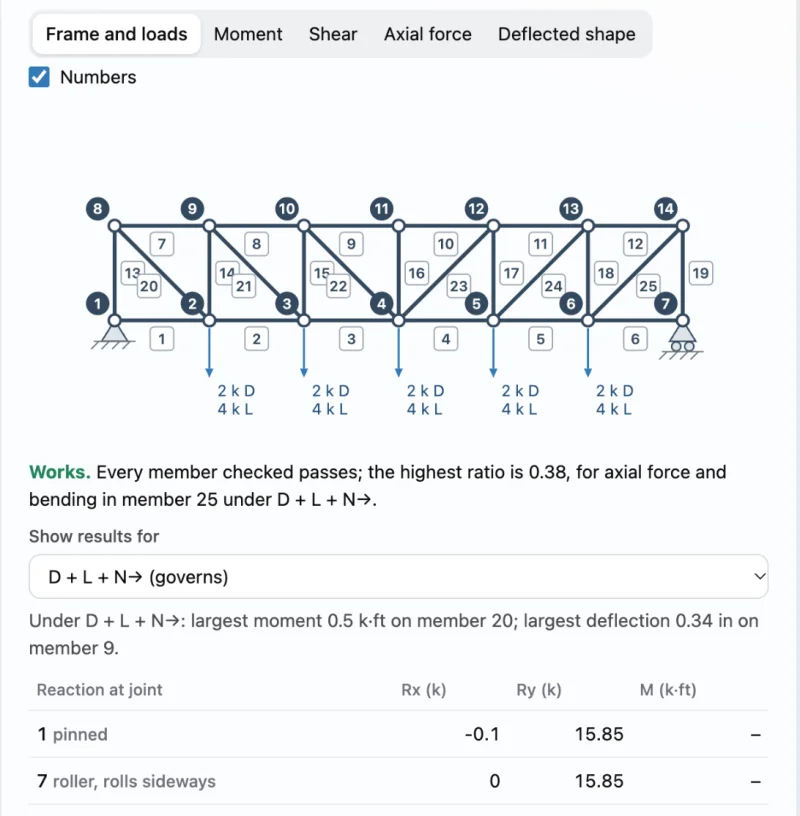
The frame designer gives reactions of 15.85 kips rather than 15, because it adds the members' own weight. Its axial forces are a little higher for the same reason: 28.2 kips in the top chord and 22.2 kips in the end diagonal. It also runs a second-order analysis and adds the small sideways notional loads of AISC's direct analysis method.
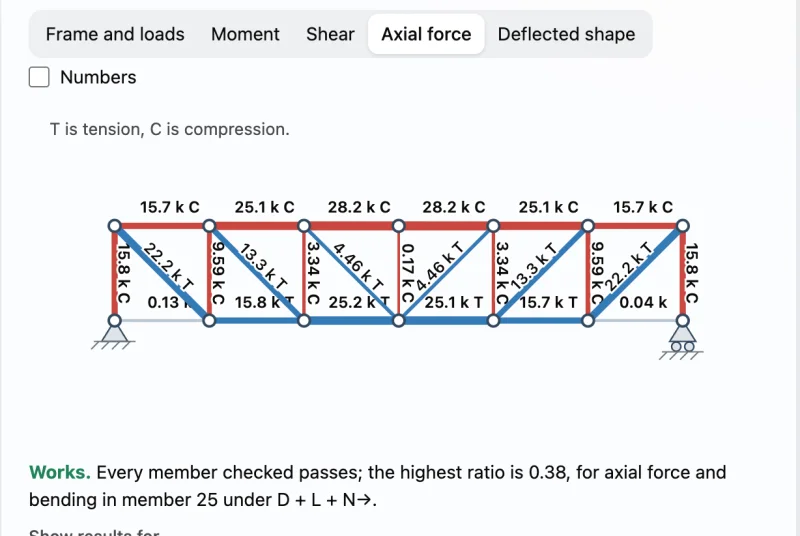
Its highest ratio is 0.38, in the end diagonals, compared with 0.29 by hand. Self-weight bends each member a little between its pinned ends, and the designer checks that bending together with the axial force (AISC 360-22 H1). From here, change the span, the depth, the loads or the sizes, and the checks update with each change.
Pratt, Howe and Warren compared
The same 36 ft truss with the same sizes and loads, laid out three ways:
| Pratt | Howe | Warren | |
|---|---|---|---|
| Diagonals | Tension | Compression | Alternate |
| Verticals | Compression | Tension | None |
| End diagonal | 21.2 kips T | 21.2 kips C | 16.8 kips C |
| Largest top chord force | 27.0 kips C | 24.0 kips C | 27.0 kips C |
| Largest bottom chord force | 24.0 kips T | 27.0 kips T | 25.5 kips T |
| Highest ratio in the frame designer | 0.38 | 0.73 | 0.41 |
The Howe's end diagonal carries the same 21.2 kips as the Pratt's, but in compression, over 8.5 ft. That roughly doubles its ratio, one reason steel trusses are more often Pratts and Warrens.
Frequently asked questions
Which members of a Pratt truss are in tension?
Under gravity load the diagonals and the bottom chord are in tension, and the verticals and the top chord are in compression. A load upward, such as wind uplift on a roof truss, reverses every force.
What's the difference between a Pratt and a Howe truss?
The diagonals slope the opposite way. In a Pratt they slope down toward the middle and are in tension; in a Howe truss they slope up toward the middle and are in compression, with the verticals in tension.
How deep should a Pratt truss be?
As a rule of thumb, roof and floor trusses are about 1/10 to 1/15 of the span deep, and bridge trusses deeper, about 1/6 to 1/10. This example is 1/6. A deeper truss has smaller chord forces, since the chord force is the moment divided by the depth, but longer web members.
Can I analyze a Pratt truss with a different span or number of panels?
Yes. Open the example in the frame designer, move the joints, and add or remove panels. It analyzes up to 50 joints.